
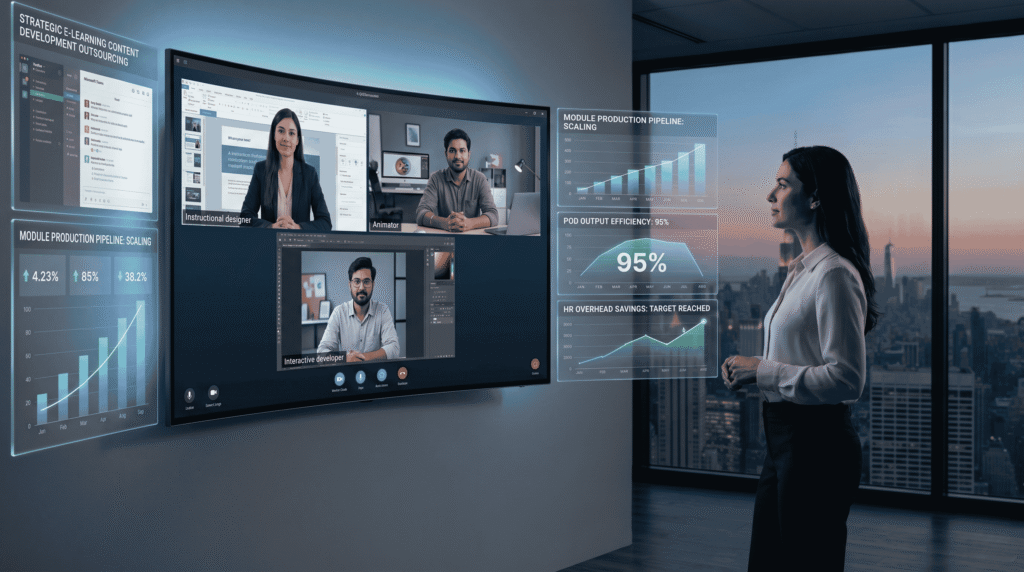
E-learning publishers, educational institutions, and internal corporate training departments face a constant operational challenge: the requirement to scale module production without dramatically increasing internal management overhead.
When course development queues stretch into multi-month backlogs, training deployment falls behind schedule, creating critical bottlenecks in compliance, sales enablement, and product onboarding.
To bypass these blocks, organizations frequently evaluate e-learning content development outsourcing. However, the marketplace is highly fragmented, leaving operations leaders to choose between low-cost freelance networks that deliver inconsistent quality or rigid legacy agencies that carry long lead times.
True efficiency requires an outsourcing framework that acts like an internal resource, delivering high-volume output under protocol-driven oversight.
Why Standard Outsourcing Paradigms Fail in L&D
The primary hesitation learning directors hold regarding external production vendors stems from previous negative experiences. Standard offshore outsourcing frequently breaks down across three predictable failure points:
- Granular Quality Control Issues: In e-learning production, minor technical or typographic mistakes can require full-scale re-work once published live.
- Asynchronous Delay Bottlenecks: Standard vendors often operate on their own local business hours, resulting in a 12-hour response lag for simple course file revisions.
- The Accountability Deficit: Direct communication with the actual developers or editors is often restricted, preventing real-time alignment on complex interactive course branches.
Consider the operational impact of a failed deployment: a prominent US e-learning provider previously utilized a low-cost, transactional vendor in Southeast Asia to build interactive training modules. The vendor delivered the packages, and the client published the content live to their users. Post-deployment auditing revealed severe structural and content errors across the assets.
Because the vendor could not be reached during US business hours, refused to join video calls, and took days to answer basic messages, the client was forced to spend significant additional capital to fix the errors. They paid twice for a single piece of work.
When your team spends hours managing an outsourcing vendor or fixing their errors, you have not bought yourself operational leverage; you have simply added another layer of operational management.
The True Cost of Building Local Headcount
When external vendors fail to deliver, the default reaction is to look toward local recruitment. However, expanding internal headcount introduces long-term payroll commitments and heavy legal overhead.
Let us review the financial math of a single US hire. According to Glassdoor data, a mid-level instructional developer or video editor with motion graphics capability earns an average base salary of $77,000 to $94,000 per year.
The base salary, however, represents only a portion of the real cost to the business. Per Bureau of Labor Statistics (BLS) data, employer taxes, healthcare benefits, and corporate overhead typically add a 25% to 40% multiplier on top of base compensation.
[ Instructional Developer Base Salary: $77,000 - $94,000 ]
      + [ Benefits, Taxes & Overhead Multiplier (25% - 40%) ]
      + [ Average Recruitment Overhead Costs: ~$4,700 ]
===========================================================
TOTAL FULLY LOADED ANNUITY COST: $96,000 - $132,000 / year per person
When you calculate the additional ~$4,700 in average recruitment costs per hire documented by SHRM data, your organization spends between $96,000 and $132,000 annually for one person. That investment yields a single point of failure when that individual faces illness, career transition, or personal leave.
A Managed Retainer Alternative: Production Pods
The alternative to high-overhead hiring or low-control freelancing is a managed creative production pod model.
TeamBoost365 delivers fully managed offshore production teams structured to operate as a direct extension of your internal workflow. Instead of dedicating corporate budget to a single local employee, the exact same financial allocation secures a dedicated multi-skilled team.
| Retainer Tier | Dedicated Personnel | Cross-Functional Skills Included | Monthly Investment |
| Essential Pod | 3 Professionals | 2D Animation, Premiere Pro Editing, Storyboard Illustration | $4,500 / month |
| Growth Pod | 5 Professionals | Motion Graphics, Interactive Storyline 360, 3DS Max Modeling | $7,300 / month |
| Studio Pod | 10 Professionals | Advanced Technical Interactive Stack & AI Workflow Acceleration | $14,000 / month |
Under this model, your internal leadership retains absolute strategic and creative direction. The production pod executes the heavy lifting, stripping away the operational drag that causes core teams to burn out.
White-Glove Integration and Broadcast-Grade Quality Control
For e-learning content development outsourcing to work effectively, the external team must build institutional knowledge of your brand preferences, toolsets, and workflow parameters. This requirement is solved through a high-touch communication framework termed white-glove service.
White-glove service dictates that your dedicated production pod operates completely within your business hours. They log directly into your communication platforms (such as Slack or Microsoft Teams), work inside your project management architecture, and join your scheduled video calls alongside your internal staff. They are completely integrated into your daily workflow.
This communication layer is anchored by a production discipline derived from 30 years of broadcast television experience. In live broadcast operations, a missed cue means going dark. We build that exact level of precision into our creative production pipeline.
Our quality control operates on a strict protocol upgrade model. Our internal rule dictates that it is acceptable to make a mistake, but it is never acceptable to repeat it. Every granular correction or style modification received from a client is immediately systemized into a production protocol for future tasks. Over time, the output requires less checking, not more.
This exact reliability system is the reason the US e-learning provider mentioned earlier transferred their entire development pipeline to TeamBoost365 after being let down by their previous vendor. They initiated the partnership with a single Essential pod to evaluate our communication speed and output quality. Today, they run 13 parallel production teams with us, with their internal staff and our offshore pods operating together as a unified unit on daily video syncs.
Scale Production Bandwidth Without HR Complexity
Opting for a systemized pod model eliminates the risk factors traditionally tied to scaling up content production volume.
- Rapid Deployment Timelines: Standard local recruitment takes months to identify and onboard talent. A dedicated TeamBoost365 pod is fully briefed, systemized, and productive within 14 business days of an signed agreement.
- Flexible Retention Terms: Contracts feature a 3-month initial commitment period, giving the pod the necessary runway to build deep institutional knowledge of your asset pipelines. Following this period, the model converts to a rolling month-to-month structure with a 30-day notice requirement.
- The 30-Day Satisfaction Escape Hatch: Every engagement is backed by our signature Confidence Guarantee. If by day 30 the pod does not feel like an integrated extension of your in-house team, your first month’s investment is refunded in full.
When evaluating e-learning content development outsourcing options, prioritize reliability, communication integration, and data-backed scale over cheap, fragmented transactional labor. Protect your internal team from burnout and clear your course roadmap with a model engineered for absolute stability.
To evaluate your current production backlog and see exactly how a managed pod fits your structural workflow, look at booking a 30-minute pre-qualification fit call. We will diagnose your roadmap and state clearly if we are a match for your goals—with no pitch decks or high-pressure sales scripts.